Texhibition Turkey: Holding Up In The Midst of Conflict
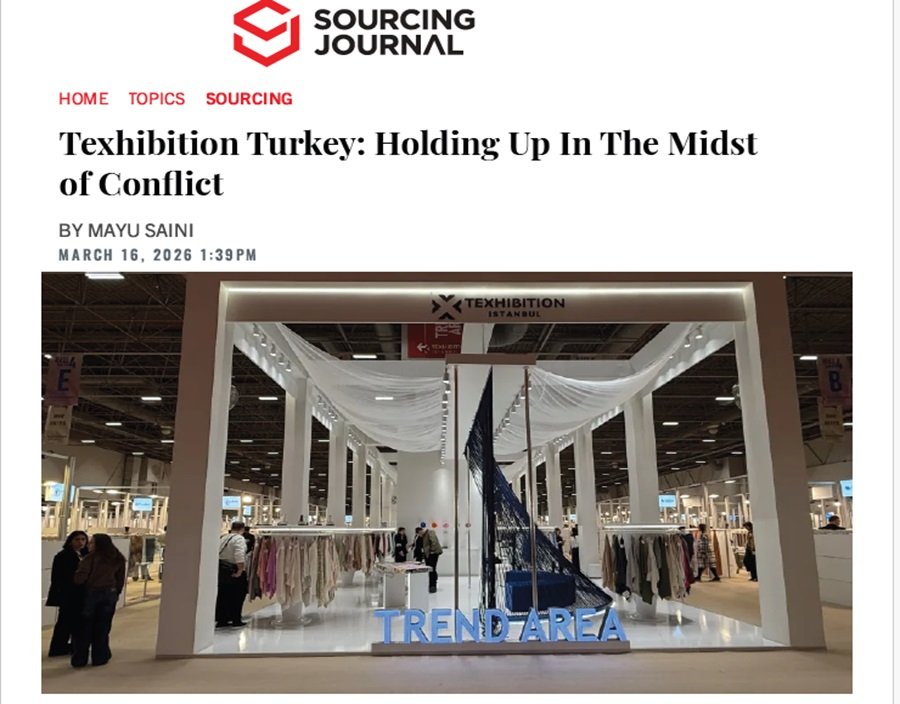
The ninth edition of Texhibition Istanbul, running March 4 to 6, opened at a fragile moment, with the conflict with Iran, and the unexpected shutdown of flights in the region.
Still, there were more than 19,325 visitors over the three-day event, more than 5,500 of them international. Some companies canceled due to uncertainty and company safety policies—a drop of about 5 percent, according to organizers.
Despite the Ramadan period, there were more than 500 exhibitors and an energetic opening ceremony attended by the heads of several organizations, including the Istanbul Textile Exporters’ Association (ITHIB), ITKIB Fuarcılık A.Ş., and the Istanbul Chamber of Commerce (ITO), which jointly organize Texhibition.
Speaking at the inauguration on March 4, Prof. Dr. Omer Bolat, minister of Trade, assured the industry of his support and said the sector should continue to focus on high-quality production despite the global geopolitical situation. “It is a bittersweet Ramadan,” he said. “Our main goal is to have regional—and global—peace. We would like the conflict to end. Without peace there is no economy, no business.”
He noted that Turkey was a $1.6 trillion economy, with GDP per capita at $13,040, and reiterated his support for the sector and the role of Texhibition in helping the industry find order in the chaos.
Aekib Avdagic, president of the Istanbul Chamber of Commerce, said that although the sector has faced difficulties such as rising costs and currency fluctuations, the commitment to textiles remains firm. “We won’t turn our back on the textile sector. Markets are changing
and we have to think about our customers and give them the products they desire. We are focusing on innovation, creating new policies and developing new trends,” he said. He emphasized that investment appetite was rising and inflation was beginning to decline.
Ahmet Öksüz, chairman of the board of the Istanbul Textile Exporters’ Association (ITHIB) said that Texhibition brought together the “vision of the sector, a joint effort by the stakeholders.”
“Even though we are struggling as markets shrink, we remain dedicated and know that we need to produce value-added products, and we are working toward that,” he said, citing the fact that growth had been extremely limited in the last year. “We are trying to increase our trade even though austerity measures affect our industry. With this exhibition we are finding ways toward a more visionary future.”
Turkey has maintained its spot as the fifth-largest textile exporter in the world. Organized by the Istanbul Textile Exporters Association (ITHIB), the sector recorded approximately $26 billion in textile and apparel exports in 2025, with textile and raw materials reaching $11.42 billion, accounting for 4.2 percent of total exports.
In 2025, Turkey exported to 195 countries, with the U.S. receiving $792 million—an increase of 1.7 percent. In the U.S., Turkey is the eighth-largest supplier of textile imports, while increasing its share in woven products.
“The event continues to grow in strength,” Mustafa Gültepe, chairman of the Turkish Exporters Assembly (TIM), told Sourcing Journal. “It’s true that many visitors from the Middle East were unable to come because of flight cancellations, but the conversations have continued, and the show provides a sense of unity for the industry as well as a strength of spirit.”
Many of the larger manufacturers appeared confident in their own spaces, as brands and retailers continued to return with repeat orders. “Long brand relationships are a kind of insurance, simply because of the comfort factor—they know what they’re getting, and that it will be good quality and responsibly delivered,” one manufacturer said.
“We are increasing sales each year and we invest in what will be the future. We closed 2025 with an increase. Each year companies are closing, but this is a 101-year-old company,” said Eda Karadogan, sales representative at Ipekis.
However, smaller manufacturers appeared to share some anxiety, worrying about bankruptcies, labor pressures and geopolitics and the general sense that “everyone was squeezing the margins.”
“We did survive 2025,” said Vakur Besim Ozek, board member of ITHIB and strategy and business development director at Bossa. “The demands of brands are changing—the level of certification and audits they want, the sustainability factors, the delivery times. The challenge is finding ways to make it through tough times and not give up.”
Selin Solak, sales representative at Antik Dantel, a company specializing in lace, spoke about the category coming center stage, as well as its changing positioning. “Lace has been showing up on all the major runways. It has become a new trend with trimmings.” He explained that with new German machines the company can produce 18,000 designs a year. The company was started in 1995 by his father and exports continue to Europe, the U.K. and the U.S. Solak said he has attended all nine editions of Texhibition.
Derya Gulen, corporate and U.S. market sales at Altinyildiz Tekstil, a Turkish brand belonging to Boyner Holdings that works with brands such as Ralph Lauren, Banana Republic and Michael Kors, said the fair has become a point of light.
“Texhibition is becoming more important for us—many of our customers are here, and it is easier to establish stronger communication with them,” he said, citing clients such as Hugo Boss, Alexander Wang and Brooks Brothers. Yet the global uncertainty is hard to ignore. “Everyone has been suffering—as of today no one has found a solution. In terms of the future outlook, we have no Plan B.”
However, the company appears to have been working with a Plan B for years: uniforms.
“This includes uniform fabrics for armies across the world, including the U.S. Army and the Qatar Army, as well as 13 different state police forces in the U.S., including Texas,” he said. Despite working with the U.S. on this count, there have been losses due to the tough and changing situation with reciprocal tariffs in 2025.
“At least a 20 percent loss of business in 2025 because of U.S. tariffs,” said Fatma Atay, export sales and marketing director at Altinyildiz. “Iran is a very important location, and logistics affect costs for all of us—petroleum, natural gas, and freight through the Strait of Hormuz. Many U.S. customers decided not to come because of company policy,” she said.
“Business is really tough. The cake is getting smaller,” Atay added. Fatih Bilici, vice president of ITHIB and president of the Texhibition Fair Committee, put it succinctly, framing the essence of the event. “Texhibition has become a bridge carrying Turkey’s production power, sustainability vision and innovative mindset to the world. And that bridge is expanding.”
Buyers at the event said they were well aware of the factors facing the Turkish market— higher prices compared to other sourcing countries in the region being among them—but they were still willing to work with them, given the higher quality of production and the advantages of nearshoring as uncertainty continues in the Middle East and around shipping routes through the Strait of Hormuz.
Outside the designated buyers’ area, where meetings were tightly scheduled, many stall owners were in animated discussions. Overall, it was clear that buyers were not giving up on Turkey.
“Normally we buy in Italy, but we are looking at new opportunities—there are different design elements here compared to Europe, and the price is interesting,” said Francesca Mascolo, leather goods raw materials research specialist at Salvatore Ferragamo SpA, who was at Texhibition for the first time.
“Customers are also more open to new designs,” she said. “We are also looking at sustainability, which is very important, and many brands buy denim here.”
Others, like Rossella Castellan, denim designer at Amiri Italy, said that although it was also their first visit to Texhibition, they realized Turkey was “different” and “could offer more solutions.”
“We are opening our minds a little bit,” said Castellan, adding that as their customer and retail base expands—with a new store opening in Milan soon, followed by others around the world—they would like to explore more.
U.K. brand Tudor Knight was clearly focused on honing the right mix during Texhibition.
“Forty percent of our business goes to Turkey,” said Kate Giler, founder and creative director. “We’re also looking for new fabric mills for wovens. The U.K. likes to trade and repeat. What’s great about Turkey is the lead time—10 weeks from Asia versus two weeks here. You can really do speed to market. We want premium fabrics and elevated detail,” she said.
While she agreed that prices may well be better in other locations—Bangladesh, for example, is an important competitor for knitwear—she said paying a premium had several advantages. “You get speed to market, design and service through the whole project. You can also place smaller orders. We’re a growing brand, so we sometimes do 200 to 1,000 units. We want good quality and we want it fast. Turkey is well adapted to smaller orders, unlike other countries. They also do fabric mixes very well.”
“It’s really useful to be here—we see a lot of newness, which is very important in fabric,” added Giler. “We have a pricing architecture—for our mass brands and different for the more premium ones—ranging from Asos to Selfridges. Our girl looks like a wealthy girl even though she may not want to spend too much, and the theme is buy now, wear whenever. It’s all about mix and match.”
On the downside, Giler noted that there has been “a massive issue with bankruptcies in Turkey.” Since many companies are strapped for cash, they want payment upfront, but there is always the risk that they may go bust in the meantime, she said.
On the last day of Texhibition, as some manufacturers paced themselves through a packed schedule of buyer meetings, others complained about the drop in visitors because of the Iran conflict. Some said their buyer numbers were down by more than 15 percent due to flight cancellations and travel concerns.
“Istanbul is one of the trade hubs of the world, and the industry has to grow faster,” said Mustafa Gültepe, who has spent years at the helm of the industry.
Looking past Egypt and its competitive advantages, the tightening pressures of geopolitics and conflict in the Middle East, there was still a sense of determination.
“I am sure tomorrow will be better,” he said, speaking in the larger sense.
As one manufacturer on the floor pointed out, the sense of collective hope emphasized at Texhibition was, in itself, something to hold on to.